
What to Wear on a First Date (Men): Comfort Is Confidence
What to wear on a first date, men: smart-casual default, fit first, dress for the venue. Pick the one you forget you're wearing — comfort reads as confidence.

The clothes are on the bed, you're forty minutes out, and you've already tried three shirts. The real problem isn't the shirt. It's that you genuinely can't tell whether you look good or just fine — and underneath that, the quiet dread of spending the whole date subtly aware of what you're wearing instead of being there with her.
Both problems have the same fix, and it's simpler than the pile on your bed suggests. You don't need the perfect outfit. You need the right default, fitted well, that you can forget you have on.
What should you wear on a first date?
Default to smart casual that fits, matched to the venue, in something comfortable enough to forget: well-fitted dark jeans or chinos, a clean plain shirt or fine knit, and clean shoes. Fit first, comfort second, venue third. That order handles almost every first date without a costume change, and it out-performs anything expensive that hangs off you wrong.
Here's the part nobody mentions: the goal of a first-date outfit isn't to be admired. It's to get out of your own way. An outfit you keep adjusting broadcasts nervousness; an outfit you've forgotten about lets the relaxed version of you show up. You're not dressing to win a look. You're dressing to free your attention for the person across the table.
Steelman first: clothes are a real input, not the whole game — a great outfit on a tense, distracted guy still under-reads, and a warm, present guy in a plain fitted tee does fine. The outfit buys you a clean start; what you do with it is the rest. And our test isn't a clinical tool — it's a structured second opinion on how your whole look lands.
Start with the smart-casual default
Smart casual is the safe center of gravity for nearly every first date, which is exactly why it should be your reflex. It's dressier than everyday but softer than a suit — considered without trying too hard, and appropriate at a coffee shop, a wine bar, or a casual restaurant alike.
The move is to keep one working smart-casual outfit ready and dial its intensity to the venue, rather than reinventing your look each time. Darker and more fitted for evening; a shade more relaxed for daytime. The full plug-and-play formula — one pick from each row — is in smart casual for men. Master that one code and the forty-minute panic disappears for good.
Fit first — it's what she reads fastest
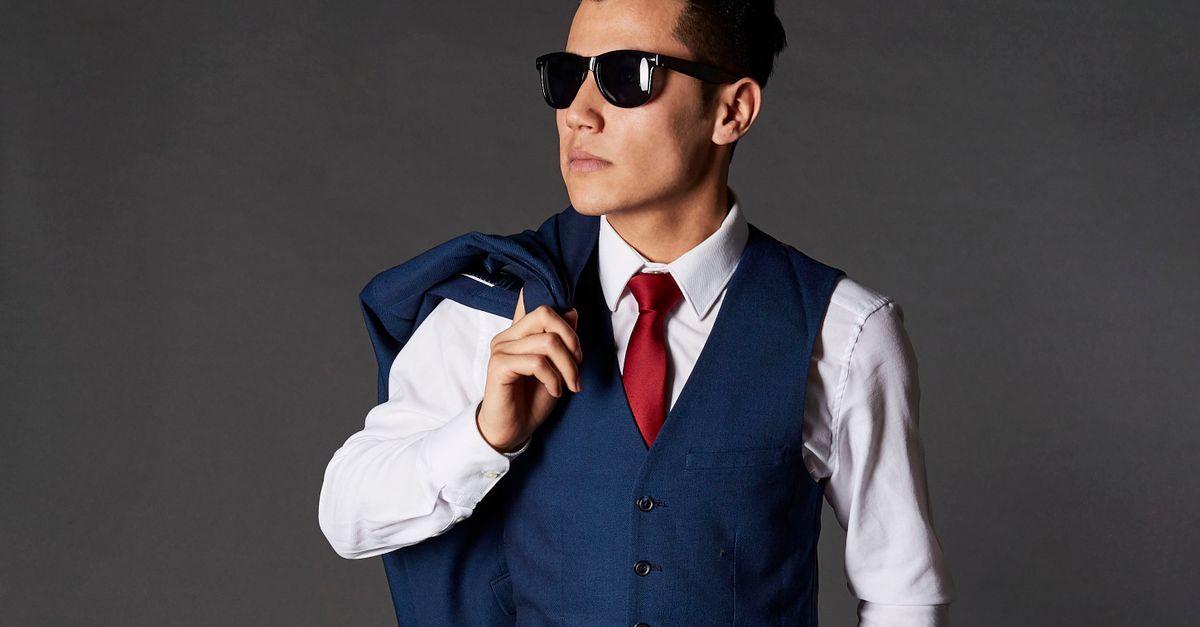
Before the pieces, the fit. It's the variable she clocks before anything else, and the one most men get wrong by wearing things a size too big.
The quick check: the shoulder seam sits at the edge of your shoulder, not down your arm. The shirt follows your torso without pulling at the buttons. Sleeves end at the wrist bone. Pants break once at the shoe, not in a puddle. A fitted plain shirt reads chosen; a baggy nice one reads default. Getting two core pieces tailored costs less than the date and does more than a new wardrobe — the full fit diagnostic is in how to dress well as a man.
Dress for the venue
Same default, different dial. A coffee walk and a steakhouse are not the same outfit, and showing up in the wrong register tells her you didn't think about the evening — or can't read a room. The target is the venue's floor, plus one small notch up.
- Coffee / daytime: fitted tee or henley, dark jeans, clean minimal sneakers. Elevated normal, not gym, not suit.
- Bar / drinks: a shirt or fine knit over dark jeans, clean boots or leather sneakers.
- Dinner: a collared shirt or knit, dark jeans or trousers, leather shoes.
- Activity date: dress for the thing, still fitted and clean — practical isn't an excuse for sloppy.
For the full occasion-by-occasion table, including summer and winter, the first-date outfit guide goes row by row.
Grooming and scent are part of the outfit
The clothes only read "put-together" if the man in them does. A fitted shirt over unwashed hair and dirty nails cancels itself out — the outfit and the grooming have to agree.
So the outfit isn't finished at the shoes. Clean nails, hair that looks deliberate, facial hair either maintained or actually shaved (the three-day in-between is the one that hurts). Then a light, clean scent — a couple of sprays, close to the skin, never a cloud. Getting the freshness base right is its own small routine, covered in how to smell good all day. Grooming is the cheapest upgrade you'll ever make and the one men most often leave on the table.
Does the outfit actually change how she reads you?
Yes — within limits, and mostly at the margin. A first impression forms in about 100 milliseconds (Willis & Todorov, 2006), and at conversational distance your outfit is already inside that window before she's finished landing on your face. Attraction is a whole-person read whose agreement runs on the overall impression, not one isolated piece (Langlois et al., 2000). A fitted, context-right outfit nudges you up near the threshold where the read tips; a baggy, default one nudges you down. It won't rewrite your face. It sets the frame your face shows up in.
| What the outfit decides | What actually drives the read |
|---|---|
| The frame your face appears in, in the first ~100ms | Whether you're present and warm once you're talking |
| Whether you read as "put thought in" or "didn't bother" | Fit, grooming, posture — the whole-person impression |
| That you match the room, not fight it | How relaxed and easy to be around you are |
| A clean start | Everything the behavior side does with it |
Dress to forget what you're wearing
Here's the reframe that ends the shirt-pile spiral: the best first-date outfit is the one you stop thinking about. Comfort isn't the opposite of looking good — comfort is what lets you look good, because an outfit you're at ease in frees you to be present, and presence is what she's actually reading. The guy tugging his too-tight collar and checking his reflection reads as nervous no matter how sharp the shirt.
So pick the fitted, venue-right outfit you can genuinely relax in, put it on, and forget it. Comfort reads as confidence because it is confidence made visible — a man who isn't managing his clothes is a man free to pay attention to her. That's the whole trick, and it's the opposite of trying harder.
The levers that actually move the needle
- Default to smart casual and dial it to the venue — one ready outfit beats a nightly reinvention. See smart casual for men.
- Fit before pieces — the shoulders and the hem decide it; tailoring is cheap.
- Match the room, plus one notch — the first-date outfit guide has the venue table.
- Finish with grooming and a light scent — the outfit isn't done at the shoes; how to look put together ties it up.
- Then stop dressing and start being present — the outfit only buys the chance; first date tips for men is what wins the second date, and the free test shows where your whole read lands first.
Key numbers
- ~100 ms — how fast a first impression forms (Willis & Todorov, 2006); at conversational distance your outfit is already inside that window.
- Whole-face, not part-by-part — the Langlois et al. 2000 meta-analysis found strangers largely agree on attractiveness, and the read runs on the overall impression, not one piece.
- 1 notch above the venue floor — the honest target; overdressing reads as trying too hard, underdressing as not bothering, and both create distance.
The bottom line
What to wear on a first date is the easiest hard question in dating: smart casual, fitted, matched to the venue, finished with clean grooming and a light scent. Then pick the version of it you can forget you're wearing — because comfort reads as confidence, and the outfit's only real job is to free you up to be present. Get that right and you've worked one of the few levers you fully control; the rest of the night is behavior, not fabric. Take the free test to see how your whole look reads before you walk out the door.
Studies referenced
- Willis, J., & Todorov, A. (2006). First impressions from facial appearance. — https://en.wikipedia.org/wiki/First_impression_%28psychology%29
- Langlois, J. H., et al. (2000). Maxims or myths of beauty? A meta-analysis. — https://pubmed.ncbi.nlm.nih.gov/10777371/
Frequently asked questions
What's a safe default outfit for a first date?
Smart casual: well-fitted dark jeans or chinos, a plain shirt or fine knit that follows your shoulders, and clean leather shoes or minimal sneakers. It works for coffee, drinks, and most casual dinners. Match the venue and dial it up or down one notch. The full formula is in smart casual for men.
Is it better to overdress or underdress for a first date?
Neither — match the venue, plus a small notch up. A suit to a casual bar reads as trying too hard; gym clothes to a nice dinner reads as not bothering. Both create distance. Aim for 'clearly put thought in' without 'performing.' The venue-by-venue breakdown is in the first-date outfit guide.
Does what I wear actually matter more than how I act on a date?
The outfit gets you a clean first read; your behavior wins the second date. Clothes are inside the ~100ms first impression, but presence and warmth carry the evening. Dress well enough to stop thinking about it, then be present — the behavior side is in first date tips for men.
How do I look good on a first date without spending money?
It's fit and cleanliness, not labels — a tailored $30 shirt out-reads a $200 one that hangs off you. Get your best existing pieces to fit your shoulders, keep everything clean and pressed, and wear clean shoes. See how your whole look reads with the free test.