
Sub 5 Male? What the Label Can't See About Your Face
Sub 5 is looks slang for 'below 5/10.' Here is the chart it comes from, the incel rebrand behind it, and why one number can't read your face.

Someone left "sub 5" under your photo. Or nobody did, and you typed it about yourself at 1 a.m. Either way, you want to know what it means and how much weight it deserves.
Here's the direct answer: in looks slang, sub 5 means "below a 5 out of 10" — a way of calling someone below average looking, aimed mostly at men and boys. Nobody measured anything to produce it.
The definition is the small part. Below: the chart it comes from (drawn, not measured), the study that caught it replacing "incel" on TikTok, why one number can't read a face, and a self-check that beats any forum verdict.
What does sub 5 mean in looks slang?
Sub 5 means rated below 5 out of 10 for looks: "below average," said like a measurement. Know Your Meme logs it as looksmaxxing slang that overlaps with "chopped," a blunter word for ugly.
It shows up in three ways:
- As an insult: "bro is sub 5" under someone's photo.
- As a self-label: "I'm sub 5, nothing works for me." The risky one: it sounds like a diagnosis.
- As a group name: "sub5s," men who believe their looks have locked them out of dating.
It sits beside mogging and the PSL tiers, and every use lacks a rater pool, an instrument and an error bar: a guess that became a "fact" by getting a number.
What does the sub 5 chart actually show?
The sub 5 chart is a forum tier ladder, and sub-5 is its bottom rung, below the three "normie" bands. It's also the only rung named for what it isn't: every band above gets an identity; the bottom gets a negation.
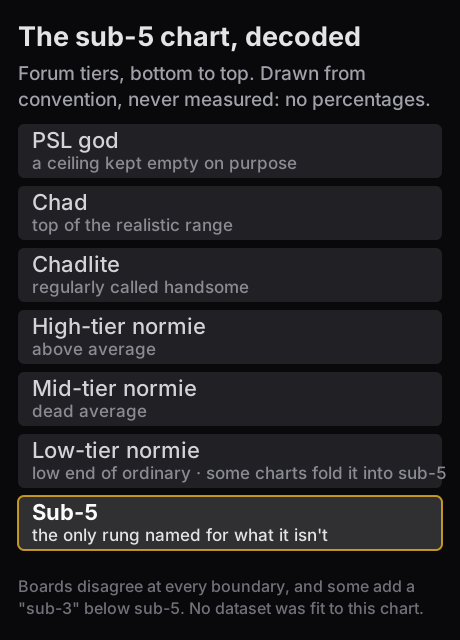
| Tier | What the chart claims | What it really says |
|---|---|---|
| PSL god, Chad | the top of the range | rare faces used as the ruler's anchor |
| Chadlite | model-adjacent | regularly called handsome |
| High-tier normie | above average | the good-looking friend |
| Mid- and low-tier normie | average to low-average | most faces you know |
| Sub-5 | below 5 | below average, by somebody's guess |
Two things the chart hides:
- Which ruler. TikTok assumes the familiar 1–10 scale. The forum PSL scale, named after three defunct boards (PUAHate, Sluthate, Lookism), usually runs 1 to 8. Its midpoint is 4.5, so a PSL "sub 5" can include perfectly average faces. Full ladder: our PSL scale guide.
- Where the lines are. Fan-made versions disagree: some fold low-tier normie into sub-5, some add a harsher "sub-3" below it. No dataset was fit to any of them. The rungs just above: high-tier normie.
Where did "sub 5" come from — and why did it replace "incel"?
"Sub 5" came out of the PSL rating forums and reached TikTok as a softer word for "incel." That isn't our spin: a 2025 study in Crime, Media, Culture by Anda Solea and Lisa Sugiura traced the migration.
Per the University of Portsmouth summary, the team analysed 25 months of data: 23 TikTok accounts, 332 videos, four looksmax.org posts and eight Incels.Wiki pages. They found:
- Accounts swapped "incels" for "sub5s" so content looked less extreme and dodged moderation.
- "Sub5s" came to mean men or boys who see themselves as unattractive, rejected or mistreated by women.
- Younger and vulnerable users are, in the lead author's words, "particularly susceptible."
Using the word on yourself? It arrived with a premise attached: your face decides your fate. The rebrand makes that sound like self-improvement. Keep the self-improvement; drop the premise.
What is a sub 5 human or sub 5 person?
The same insult in meme form, and the stretch is the point: a below-5 face supposedly doesn't count as a person. One image in the Know Your Meme gallery says sub 5s "won't get viewed as human."
If it was aimed at you:
- It's gender-neutral in comments, but the forums that coined it mean men.
- It's built to slip past filters. Sugiura has noted that platforms can't always tell when the term is being used to bully.
- "Who is sub 5?" has no answer. No list, no cutoff, no judges. Whoever typed it was the entire panel.
Is being a sub 5 male bad?
Less than the label claims. The concession first: in 11 meta-analyses, Langlois and colleagues found that raters agree about who is attractive, within and across cultures, and that attractive people are treated better. Anyone telling you looks are 100% subjective is selling comfort.
But agreement is a tendency, not a single ruler:
- In three experiments, Hönekopp found private taste is about as powerful as shared taste when people judge faces.
- A twin study estimated that 48% of the variation in face ratings comes from preferences people share, and 52% from preferences they don't (Germine et al., 2015).
Call the error at the heart of the label the One-Ruler Fallacy: treating the average of many different rulers as the one ruler every woman carries. One number throws away the half of the signal where real dating happens. You don't need the average of all women. You need some of them.
Fair limit: averages matter most on photo-first dating apps, where faces compete side by side — the arena least like the rest of your life.
Do I have a sub 5 face? A self-check that beats a forum verdict
You can't answer this from one selfie in a bad mood. A sub-5 verdict can't see the camera, the judge's bias (often yours), or the difference between bone structure and a bad haircut. Check those yourself:
- Fix the photo before judging the face. A selfie taken about 12 inches away makes a man's nose look roughly 30% larger than an undistorted image; at 5 feet the effect essentially disappears (Ward et al., 2018). Retake it on the back camera, at eye level, beside a window (why the front camera lies).
- Discount your own verdict. Self-ratings and other people's ratings of attractiveness correlate at only about .24, "largely orthogonal" in Feingold's words; see how accurate your self-image is.
- Separate bone structure from the presentation floor. Most "sub-5 features" are the floor:
| Signal | The sub-5 story | What it usually is | Movable? |
|---|---|---|---|
| Skin | "Bad genetics" | Sleep, sun, basic skincare | Yes |
| Hair and beard line | "Wrong face" | Wrong cut for the face | Yes |
| Body composition | "Bad frame" | Training and diet debt | Mostly |
| Clothes fit | Not even noticed | Off-the-rack sizing | Yes, immediately |
| Bone structure | The whole verdict | One input among many | No |
- Get one outside read, then stop checking. Our photo test takes about a minute and gives a first-impression read on a 70–155 perception axis: no tiers, no 1–10. You see the band your read lands in before paying; the full report, with your natural ceiling and the levers that would move your read most, is $5 one-time. It's not a clinical instrument, just one calibrated data point instead of a stranger's comment. If the floor needs work, start with how to look more attractive as a man.

What if the sub 5 label has started running your day?
Then it has stopped being a looks question. The NHS lists spending a lot of time comparing your looks with other people's as a sign of body dysmorphic disorder, which is treatable — one conversation with a doctor or therapist beats any chart. Checking charts nightly? Quitting the forums is a legitimate first move, not a surrender. And if the label has slid into thoughts of not wanting to be here, call or text 988 in the US tonight.
There is no version of your face that requires you to give up.
The bottom line
- Sub 5 is looks slang for "below 5/10": an insult or self-label from a chart that was drawn, not measured.
- The word was a rebrand: TikTok accounts swapped "sub5s" in for "incels."
- The One-Ruler Fallacy: about half of face judgment is personal taste, so no single number is your verdict.
If you're going to carry a number, make it one somebody measured: see how your photo reads in about a minute.
Studies referenced
- Feingold, A. (1992). Good-looking people are not what we think. Psychological Bulletin, 111(2), 304–341. https://doi.org/10.1037/0033-2909.111.2.304
- Germine, L., et al. (2015). Individual aesthetic preferences for faces are shaped mostly by environments, not genes. Current Biology, 25(20), 2684–2689. https://doi.org/10.1016/j.cub.2015.08.048
- Hönekopp, J. (2006). Once more: Is beauty in the eye of the beholder? Relative contributions of private and shared taste to judgments of facial attractiveness. Journal of Experimental Psychology: Human Perception and Performance, 32(2), 199–209. https://doi.org/10.1037/0096-1523.32.2.199
- Langlois, J. H., et al. (2000). Maxims or myths of beauty? A meta-analytic and theoretical review. Psychological Bulletin, 126(3), 390–423. https://doi.org/10.1037/0033-2909.126.3.390
- Solea, A. I., & Sugiura, L. (2025). Digital subcultural diffusion theory: Rebranding the incel ideology through looksmaxxing, sub5s and the PSL scale. Crime, Media, Culture. https://doi.org/10.1177/17416590251387245
- Ward, B., et al. (2018). Nasal distortion in short-distance photographs: The selfie effect. JAMA Facial Plastic Surgery, 20(4), 333–335. https://doi.org/10.1001/jamafacial.2018.0009
Frequently asked questions
Is sub 5 an insult?
Usually, yes: it is a put-down dressed as a number, sometimes used as a joke or about oneself, and it mostly targets men and boys. If it was aimed at you, it tells you about the commenter's vocabulary, not your face; am I ugly is the calmer version of that question.
Does sub 5 mean below average?
That is the claim. On the familiar 1-10 attractiveness scale, 5 is the middle, so sub 5 asserts below average; on the forum PSL scale, which usually runs 1 to 8, a sub 5 can include average faces. Either way, nobody measured it.
What is the difference between sub 5 and sub 3?
Both are bottom bins on fan-made tier charts, and some charts carve a harsher sub 3 out underneath sub 5. Neither has a measured cutoff or a rater pool behind it, so the difference is tone, not data. The whole ladder is laid out in the PSL scale guide.
What does true sub 5 mean?
In forum talk, 'true' marks a verdict meant to be permanent: below 5 even at your best, pinned on bone structure rather than grooming. Nobody can make that call from a close-up selfie, which distorts the face and hides the presentation floor, as why you look bad in pictures explains.
Is there a sub 5 test?
No test can certify a forum tier, because the tiers were never defined with data. What you can check is how your photo reads to strangers: our photo test takes about a minute and reads you on a 70-155 perception axis, not a tier or a 1-10 number; the analysis runs before you pay, and the full report is a one-time $5.